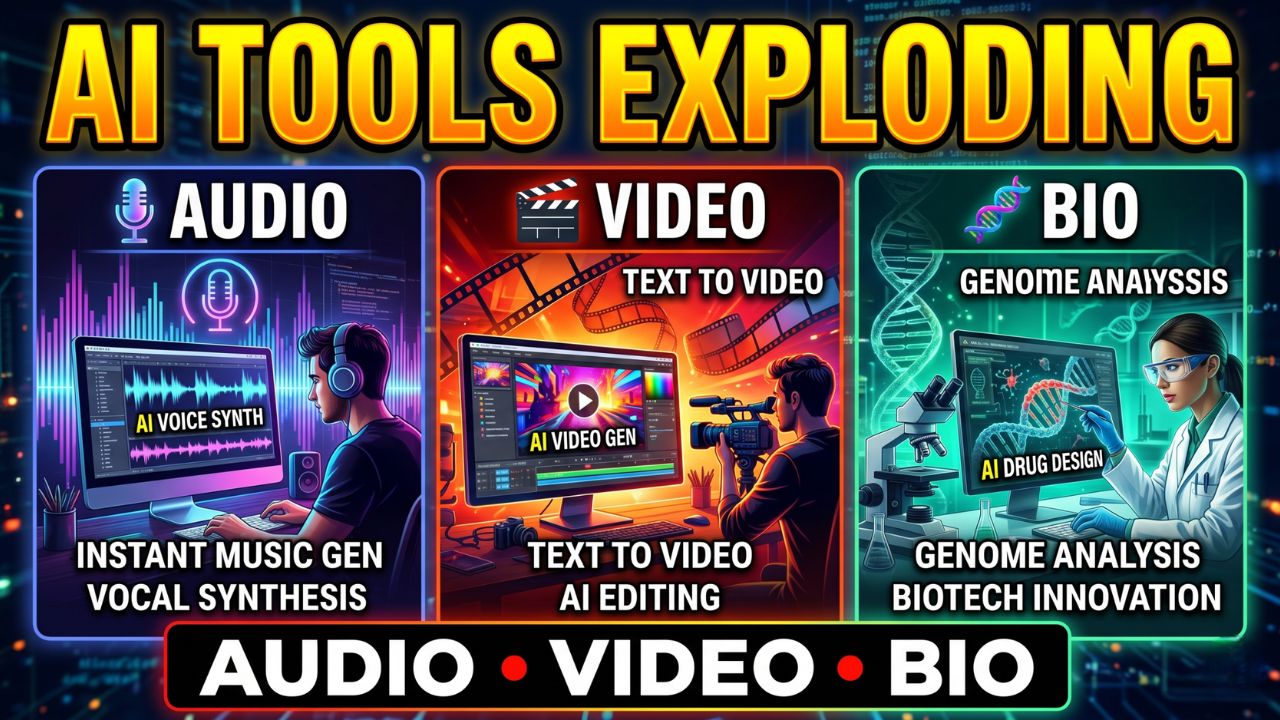
Friends, companies from China are rapidly advancing in the world of AI. Recently, several Chinese startups and tech firms have launched new AI tools that could significantly impact sectors like audio, video editing, and biotech.
This wave of innovation prominently features companies like Xiaomi, along with AI-for-science startups and advanced video editing platforms. Let’s break down these developments in a simple and clear way.
Xiaomi’s MiMo-V2.5: A Major Upgrade in Voice AI
First, let’s talk about Xiaomi’s new AI voice model, MiMo-V2.5.
This is not just a basic TTS (Text-to-Speech) model—it also includes advanced features like voice cloning and voice design. Now, you can clone a real human voice using just a few seconds of reference audio.
Even more interesting, you can generate entirely new voice styles using natural language prompts—for example, “a soft female voice with a calm tone,” and the AI will create it accordingly.
Additionally, the MiMo-V2.5-ASR (speech recognition) model has been open-sourced. It is designed to perform well in complex scenarios such as bilingual speech (Chinese + English), dialects, noisy environments, and multi-speaker situations.
StepAudio 2.5: Faster and More Accurate Transcription
Another major development in audio AI is StepAudio 2.5. This model uses LLM-based inference acceleration to improve both speed and accuracy in transcription. It can be used in meetings, voice assistants, media processing, and long-audio recognition. In simple terms, even long recordings can now be converted into text quickly and accurately.
Buzzy: Video Editing Becomes as Easy as Photoshop
In the video editing space, a new AI platform called Buzzy has been introduced, often described as “Photoshop for video.”
The key feature of this platform is that you can edit videos using simple text commands. For example:
- Remove background people
- Fix lighting
- Replace products
- Change scenes or camera angles
This means even complex video editing can now be done without technical skills.
4K AI Video Generation: Cinema-Quality Output
AI video generation has also seen a major upgrade. New Video 3.0 systems now support direct 4K output. This means you can generate high-quality, cinematic videos directly using AI, without needing additional editing.
AI in Biotech: The Rise of the “AI Scientist”
AI is no longer limited to tech—it is rapidly expanding into healthcare and biotech. A Chinese startup “奥明星程” (AI for Science) has raised over 100 million yuan in a Series A funding round and is working on an “AI scientist” system.
This system is building a biological intelligence infrastructure where diseases can be screened using just a blood sample. One of its products, OS-TuFEst-BRCA, focuses on early breast cancer screening and molecular subtyping, with a reported sensitivity of 92%–95%.
Why These AI Developments Matter
When you look at all these updates together, it becomes clear that AI is no longer limited to chatbots.
Now AI can:
- Create and clone voices
- Edit videos
- Analyze health data
In short, AI is transforming how work is done across industries.
What Could Change in the Future?
In the coming years, these AI tools could make life much easier for creators, developers, and even medical professionals. While content creation will become more efficient, advancements in healthcare could enable early diagnosis and potentially save lives.
Conclusion
Chinese AI startups are currently moving fast in terms of innovation. Whether it’s voice AI, video editing, or biotech—new tools are being launched across every sector. If this pace continues, AI will become an even bigger part of our daily lives in the near future.